Wednesday, March 28, 2007

Lame contest

I've poked a little fun at the National MS Society's new marketing campaign slogan--"MS stops people from moving. We exist to make sure it doesn't." But I think it would be helpful if we could lend a hand to the Society and its marketing geniuses. So, in the interest of being part of the solution, being team players, I'm announcing a contest to come up with a better slogan. Here's how it works: we're going to stick with the format of the current slogan. So your suggestions should fit the following model:
MS stops people from _____. We exist to make sure _____.

Here, I'll get the ball rolling:

MS stops people from playing in marching bands. We exist to make sure there's something to watch during halftime at high school football games.

MS stops people from joining the army. We exist to make sure every American platoon in Iraq has at least one guy who always has to pee.

MS stops people from attempting 58 of the 64 sexual positions described in the Kama Sutra. We exist to make sure you get a chance at those other 6, including the one known as "the barking rabbit".


Prize? I haven't decided. Rules? I reserve the right to make them up arbitrarily. Go nuts.

Signs of spring

1. Robin.
2. Crocuses.
3. End of maple sap.
4. Smelly asparagus pee (you know what I mean).

Wednesday, March 21, 2007

Is big pharma paying your doctor?

Very interesting piece in today's NYT about records showing drug company payments to Minnesota docs. See, Minnesota is one of a few states with a law requiring drug makers to disclose what they're paying providers. Snip:
The Minnesota records begin in 1997. From then through 2005, drug makers paid more than 5,500 doctors, nurses and other health care workers in the state at least $57 million. Another $40 million went to clinics, research centers and other organizations. More than 20 percent of the state’s licensed physicians received money. The median payment per consultant was $1,000; more than 100 people received more than $100,000.
....
There is nothing illegal about doctors’ accepting money for marketing talks, and professional organizations have largely ignored the issue. But research shows that doctors who have close relationships with drug makers tend to prescribe more, newer and pricier drugs — whether or not they are in the best interests of patients. “When honest human beings have a vested stake in seeing the world in a particular way, they’re incapable of objectivity and independence,” said Max H. Bazerman, a professor at Harvard Business School. “A doctor who represents a pharmaceutical company will tend to see the data in a slightly more positive light and as a result will overprescribe that company’s drugs.”

I have a great deal of respect for the handful of doctors who make up my medical posse, and it would never occur to me that they might be influenced by whatever goodies Serono, Berlex, Biogen, or Teva might be passing out. And I'm sure that my posse honestly believe that they haven't been, and couldn't be, influenced by goodies from drug companies. But there are dump-trucks full of money at stake for the drug companies, and you have to believe that there are lots of really smart people working very hard to influence my posse and your posse in very subtle ways, so that more of those dump-trucks end up headed in their direction.

So what's a patient to do, especially if you don't live in Minnesota or another state that requires disclosure? Is this something worth asking your doctor, even if it might be offensive? Over the last 13 years, I've been on each of the CRAB drugs for a while, switching drugs when I switched neurologists, based on their advice. And now I wonder whether any of my switches were influenced by drug company marketing efforts aimed at my neurologists.
Link.

Tuesday, March 20, 2007

Pool running

Just got back from the local high school pool, where I've doing some pool running and lap swimming. Over lunch, I can drive to the pool, get a good 20 minutes in the water, and get back to work without unduly stretching my lunch hour, although I'm sorta pooped when I get back to work.

I'm especially pooped when I first get out of the pool. This means that it's sometimes hard to haul myself out of the water, and I'm rather wobbly on the way back to the locker room. It also means that my brain may not be functioning correctly for several minutes. This happens to me whenever I get fatigued, and it's especially apparent in my speech, which becomes labored and occasionally garbled, like my penmanship when I try to write left-handed.

So I get out of the pool today, and, as is often the case, it's just me and the lifeguard. As I walk by her, she picks up the punch-card that I use to pay for admission, and sees that it's got my wife's name, which she doesn't recognize. She asks me, "Is this yours?" I look at the card, then say something like "Ohio
lunchbox, apparently." This has happened to me before: a lifeguard will ask me if I had a good swim, and I reply, "Frozen pancakes in the boot, Helen."

It's a little embarrassing.

Monday, March 12, 2007

Early spring ritual


Last Friday was a beautiful day: sunny and warm, maybe in the low 40s, so I left work early to tap the trees. We've got a few good sized sugar maples in the yard, enough for five taps that, in a good year, produce enough sap to give us a gallon of real maple syrup. This is our fifth year of back-yard sugarin', and drilling that first hole and watching the sap start to drip down the trunk of the tree brings back some bittersweet memories.

Our first try was in March 2002. Back then, we lived up north, had just bought our first house. The house sat on a couple acres, maybe half of which was wooded with a mix of popples and maples and birches. Up there, hobby-level maple sugaring was common enough that you could buy the taps and stuff at the corner hardware store. That first year, spring came early, and I remember seeing little beads of sap on the very tip of every little twig on the big old maple out back. I also remember sitting on the back stoop, sipping a beer and watching the kettle boil as the sun set, and thinking I never wanted to live anywhere else.

But after that second year, we sold the house and moved to Chicago. We left the taps and the burner in the garage for the new owner. After a miserable year in Chicago, we moved to our current digs, where we restarted our early spring hobby. I think we missed last season for one reason or another, but it was good to fire up the kettle on Saturday and smell the familiar smell of boiling sap.

This year, there was still several inches of snow outside when I headed out with the drill, which made it tougher to get where I was going, but easier to avoid stepping in the dog turds out back. I'm a little weaker and a little tippier than the last time I did this, and I was ready for a rest when I finished. As I slouched in my big ugly recliner, where I seem to spend more and more time slouching and thinking, I thought about where I was and who I was the first time I drilled into a leafless maple tree.

I still miss living up north, but I think mostly I miss the person I was then, seven or eight years ago: active, fairly fit, and optimistic about my ability to control my own future. A couple weeks ago, I thought about heading out to the ski hill to see what would happen if I put on my skis and pointed them downhill. I used to ski a lot up north, but I haven't been out for a few years now. I just ran out of energy and stayed home, though. Gravity is much less of a friend than it used to be; I spend a lot more time fighting it and a lot less time enjoying it. But it still makes the sap drip down into the jugs in early March.

Monday, March 05, 2007

Orange, apparently

It's National MS Awareness Week, and I forgot to buy you a present. Last night, there was a woman on the local news talking about what it's like to have MS. Today, the National MS Society announces its new MS 'branding' initiative. Snip:
In an effort to help make MS more relevant to busy people in a busy world, over the past year, the advertising agency Wieden+Kennedy New York, whose corporate clients include Nike, Coca Cola and Starbucks, has worked pro bono with the MS Society to develop a campaign to totally transform the way MS and the National MS Society is viewed right down to the very color that has been associated with the disease for the past 60 years. The ground-breaking initiative introduces a new way of talking about MS that focuses on the universal elements of what it means to live with this chronic and unpredictable disease. The agency donated over $1 million in time and creative talent.

This outpouring of creative talent has given the Society a new tag line ("MS stops people from moving. We exist to make sure it doesn't."), and a new color: orange. That's right, orange. See, all your really cool diseases have their own colors (pink for breast cancer, red for AIDS, yellow for testicular cancer, for some odd reason), and we really want a piece of that action. So start thinking about what in your wardrobe will look really smashing with a little orange ribbon.

Well, whatever. I guess I'm resigned to the idea that effective PR is an important component of the fight against MS, mainly because this country has not made access to healthcare or funding for research a priority. On the other hand, I'm not inclined to politely applaud Wieden+Kennedy's creativity for the new color and Society logo (which consists of the capital letters "MS" in orange with a black slash through them) just because they use a plus sign instead of an ampersand. Really, how long did they sit around thinking about the new logo before they came up with that one?

Wednesday, February 28, 2007

Happiness is...not breaking the skin

I experience the greatest muscle dysfunction at the very end of the day, when I'm too beat to stand up straight, and at the very beginning of the day, when the process of getting myself out of bed is like trying to get a very big, very comfortable dog off of the couch. In the morning, it starts with the sort of horizontal stretch that we are all accustomed to making before swinging our feet onto the floor. Often, that first stretch ends up as a whole-body spasm where my arms and legs go simultaneously stiff and jumpy. It's hard to describe, that brief sensation of being both uncontrollably rigid and uncontrollably jumpy.

This morning, the clock radio went off at the usual time, and I turned over to give my wife a snuggly good morning hug. She'd been out of town for a while, and it was really nice to wake up and remember that she was there with me. But in the process of turning over, I triggered that weird shuddering spasm, and kicked her in the shin with my big toe. "It's OK," she said, "I don't think you broke the skin."

Speaking of love and illness, I really enjoyed reading this article in WaPo about what it's like to be a young breast cancer survivor.

Monday, February 26, 2007

After a weekend blizzard, TGIM

More than a foot of snow over the weekend: a spectacular work of nature and, on a weekend when I'm home alone, a spectacular pain in the ass. Thank heavens for the little electric snowblower, which exceeded expectations in wet, heavy snow. Still, it turned into a weekend when my energy went into the driveway, leaving me rubberlegged and too tired to do anything interesting. Even today, I'm feeling tired and unfocused; I can't seem to get much done.

On top of everything, it's pledge week on public radio.

Wednesday, February 14, 2007

Study: treadmill training for MS patients


Today, there's a passle of new abstracts to peruse from the journal Multiple Sclerosis. Lots of stuff about depression, cognition, and pain, and a report from a small study investigating the impact of treadmill training on walking effort and fatigue. Bottom line: for the study's 16 participants, 12 sessions of up to 30 minutes on the treadmill improved comfortable walking speed and endurance. We just got our basement tidied up; maybe there ought to be a treadmill down there. They're expensive little buggers, but maybe a used treadmill?

Link to abstract.

Tuesday, February 13, 2007

States address health care; feds, not so much

Today's NYT highlights states' efforts to expand health coverage through current programs like SCHIP and Medicaid, even as the Bush administration calls for returning those programs to their "original objective" of providing coverage for people with incomes at twice the federal poverty level or below (that's about $41,000 a year for a family of four, or about $27,000 a year for a two-person family like mine). Snip:
In Washington, health policy debates highlight the ideological divide between Republicans and Democrats over the proper role of government in helping the uninsured. Governors and state legislators tend to be more pragmatic.

“There is such a political divide in Washington that many people believe that the only reasonable chance to succeed is at the state level,” said Jeffrey S. Crowley, a senior research scholar at the Health Policy Institute of Georgetown University.
...
In his budget, Mr. Bush said the way to transform the health care system was by “subsidizing the purchase of private insurance,” not by expanding public programs in a way that would increase costs to the federal government.

I've got two basic problems with the administration's position. First, isn't it inevitable that 'subsidizing the purchase of private insurance' will increase costs to the federal government just as surely as the expansion of public programs? Sure, we can argue about which costs more, but if an 'ideological divide' separates the two, I just don't see it as about cost; it looks a lot more like a preference on the part of the administration to assure a role for commercial health insurers.

Secondly, and more importantly, I can't see that the administration's tax deduction proposal would cause anything like the transformational change needed to fix the problem. We can trim all the fat out of the current system through republican ideas like eliminating the tax incentive for Cadillac plans, tort reform, and cost transparency, but you can't really escape the fundamental principle that we need healthy people to help pay to care for sick people.

Link.

Marijuana effective for HIV-related peripheral neuropathy

A study involving HIV patients demonstrates that smoking pot is effective at relieving foot pain from peripheral neuropathy. Snip:
The study, conducted at San Francisco General Hospital from 2003 to 2005 and published Monday in the journal Neurology, involved 50 patients suffering from HIV-related foot pain known as peripheral neuropathy. There are no drugs specifically approved to treat that kind of pain. Three times daily for nearly a week, the patients smoked marijuana cigarettes machine-rolled at the National Institute of Drug Abuse, the only legal source for the drug recognized by the federal government.

Half the patients received marijuana, while the other 25 received placebo cigarettes that lacked the drug's active ingredient, tetrahydrocannabinol. Scientists said the study was the first one published that used a comparison group, which is generally considered the gold standard for scientific research. Thirteen patients who received marijuana told doctors their pain eased by at least a third after smoking pot, while only six of those smoking placebos said likewise. The marijuana smokers reported an average pain reduction of 34 percent, double the drop reported by the placebo smokers as measured with a widely accepted pain scale.

That jives with my experience with pot's effect on my MS-related peripheral neuropathy, I guess, but I can't really see myself functioning particularly well on 3 joints a day. I wonder whether this study was able to prevent the unmasking of pot vs. placebo by participants who could tell they were high, or not.
Link.
Update: here's a link to a WaPo story on the same study.

Thursday, February 08, 2007

What not to eat


Just heard an interesting piece on NPR about a woman who studies mushrooms, in particular Amanita phalloides, the death cap. I've got a thing for mushrooms, both the 6 species I'm comfortable picking and eating, and the gazillion others I like to look at and poke and photograph. It's an interesting piece, and I was surprised to learn that phalloides isn't in fact a native species. Actually, it's a European invader. Whatever its origin, it's the reason I stomp any white mushroom with a veil (the ringey thing on the stem) when I'm up at the cabin.

Wednesday, February 07, 2007

Education, money, and artificial milestones

I've been paying on my student loans for close to 10 years now. I've always told myself that going into debt to the tune of $50,000 total for my undergrad degree and my law degree was a fabulous investment in my own earning potential. After 10 years, I think I finally believe that's true.

God help me, for the first year, I actually paid on the 10-year schedule, because the idea of being so far in hock annoyed me. After a year, though, I went ahead and consolidated to lock in what seemed at the time to be a ridiculously low interest rate: 5.25% (although the rate eventually went even lower than that). Around the same time, I started putting $50 per month into an IRA.

Since then, I've kept hacking away at the student loans at $300 a month, watching how they've gone from paying almost all interest and principal to maybe half and half, taking advantage of the student loan interest deduction as it was phased in. At the same time, I've tried to keep contributing a bigger and bigger chunk of my earnings to retirement savings, initially just to the IRA, then to a 401k, and now to 403b. I'm up to $500/month, which is about 8.5% of my gross salary. In the last year, I've also bought a few individual stocks, too.

Thanks to the interwebs, I can, at any moment, watch my savings go up (or down) and watch my student loan balance go down. Recently, I realized that I had passed the point where the balance on my student loans was about equal to the amount in savings. So in a sense, I guess I've finally got myself back to zero (although in a different, more real sense, I'm still plenty in hock, onnacounta a mortgage, another year of car payments, and some outstanding debt for the purchase of a couch and a couple chairs, not to mention the fact that my retirement savings are pretty damn illiquid).

Then, there's a distinct possibility that the family educational debt stands a pretty good chance of going up. My wife is pretty seriously thinking (with my not-so-subtle encouragement) about going back to school to get a nursing degree. Seems like a good fit for her. The only problem is that despite an abundance of nursing programs in the area, there seem to be significant waiting lists to get in. So despite the acknowledged shortage of nurses, we're not so much short of people who want to be trained as we are short of people to do the training, at least that seems to be the story around here.

Friday, February 02, 2007

Do/be, doobie

It's cold and sunny today, the kind of cold that almost explodes your head when draw in that first outdoor breath of the morning. Over the weekend, we might not make it above 0 (that's Fahrenheit, folks), which means that this weekend is unlikely to be the weekend when I finally get out and enjoy some kind of winter fun like ice fishing or skiing. That's kind of disappointing.

For the last few weeks, I've had the annoying feeling that my life had become dramatically less interesting than it had been just a couple years ago. Last Friday, I drove to see an old friend who lives an hour and a half away, partly because I wanted to borrow his sausage grinder attachment, and partly because I just felt like doing something alone. It was good to see him, as always. He's one of just a few people that I think of as close friends. But it felt sorta strange to be doing something without my wife. And the more I thought about it, the more I realized how unusual it has become for me to be out and about, hanging out with a friend, and not accompanied by my wife.

These days, it feels like my life has shrunk down to basically 1) getting ready for work, 2) being at work, 3) watching TV after work, and 4) sleeping. The occasions on which I am alone are generally the times when I am engaged in activity #3 and my wife is doing stuff with a friend. It didn't used to be that way. It used to be that I spent a considerable amount of time alone but doing stuff, and I felt like the stuff I did other than working was the stuff that more or less defined who I was as a person. A former teacher of mine used to say, "The more you do, the more you are," and it seemed right.

But now, I do less. I just don't have the juice after work to do much of anything except occupy my big ugly green recliner. Last night, my wife went with a friend to go see "The Queen" with the very fabulous Dame Helen Mirren. I stayed home, fired up the bong, watched old episodes of "Connections" with shaggy old James Burke, and ate a pint of ice cream. And the kicker is that even going to work doens't really feel like doing much of anything. My job is not particularly demanding, my work is generally not subject to real deadlines, so I sort of plod along for 8 hours, get back in the car, and go home. None of the anxiety, the excitement, the ego-inflating opportunities to demonstrate one's brilliance that I had in private practice.

Again today, I will wander my way through 8 hours at the office, stopping frequently to check out the latest news/stock prices/Amazon.com Friday Sale items or to play a game of Solitaire, maybe answering the phone a few times, then I will get back into the car, drive home, open a beer, and watch the news. My wife will be out for cocktails with former coworkers. I will probably bake a loaf of bread and eat several slices of it while watching through googly eyes as James Burke explains how the discovery of earwax in ancient China led to the development of the modern cellular phone.

Tuesday, January 30, 2007

MS prevalence up?

A number of media outlets (e.g., CBS News) are reporting on a study published today that indicates MS prevalence is up 50% since 1982 to .9 cases per thousand. Are more people getting sick or are more people getting diagnosed? Don't know, but it's starting to seem like there really ought to be at least one charismatic, young A-list celebrity with MS who can do for this disease what Michael J. Fox has done for Parkinson's. Annette Funicello's too old; Squiggy's too old and kinda obscure; Teri Garr's too old and kinda flaky; Montel Williams is close, but still a bit too old (sorry guys, it's strictly business).

What we need is someone who, like Michael J. Fox, has been in the mainstream public eye so pervasively that he or she feels like somebody we all know and grew up with. What are we doing wrong?

Wednesday, January 24, 2007

Doing some math on the Bush tax plan

Here's how the Bush tax plan for health insurance works out for me, I think: The total premium for my employer-provided family HMO coverage is $1050 per month (of which I pay $68 per month). If the value of my coverage is computed based on what my employer pays, $982 per month or $11,784 per year, that yields a deduction of $3,216 ($15,000 - $11,784). At our marginal tax rate of 15% (last year, anyway), that means we'll pay about $482 less in taxes than I would have without the deduction.

So that's nice, I guess. But the question I have is, what's the government getting in terms of its stated goal of expanding health coverage for that outlay? Well, I guess it's discouraging the kind of Cadillac plan for which people are going to end up losing some tax deductions. And I guess the argument is that by penalizing the Cadillac plan, we're somehow discouraging the rising cost of health care in the country. So, OK. But as I understand it, the deduction for people like me with Hyundai plans won't be totally offset by the deductions lost by Cadillac people for a number of years. In fact, the only reason the Cadillacs will eventually zero out the Hyundais is because the $15,000 figure won't go up as fast as my Hyundai policy goes up. So eventually, even the Hyundais will end up losing the goodies they'd get early on, and end up being contributors to the tax subsidy (sorta the way families with moderate incomes have been swept up by the alternative minimum tax).

And what about that subsidy? In the beginning, I get a nice little piece of that action, even though it's going to cost the government in the beginning. But eventually, me and fellow Hyundais are going to be kicking in money to subsidize somebody else's tax deduction. The thinking is that the tax subsidy is going to make it possible for somebody who isn't presently covered to get coverage.

I don't think it's a bad idea to quit using the tax code to subsidize Cadillac health coverage, and I don't think it's a bad idea to use the tax code to subsidize Hyundai coverage for people who don't have any. I just think it's another example of too little, too late. There are millions of people without coverage, and many of them aren't going to benefit in a meaningful way from a tax deduction.

For a different take on the Bush plan, check out Ruth Marcus's piece in today's WaPo. And for an interesting peek into Bush's SOTUs, check out NYT's interactive feature that lets you search the text of Bush's SOTUs for keywords. Search for "health" and watch the 6-year evolution of the Bush health policy agenda.

Tuesday, January 23, 2007

Bread: It takes a village

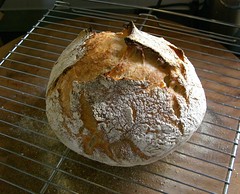
For the last six weeks or so, I've been baking two or three loaves of bread a week. It's Mark Bittman's No-Knead Bread recipe, and it's sweeping the nation, or at least the bread-loving segment of the nation. Most of my loaves have come out lovely, with the exception of the loaf I tried to make with the bran-speckled organic stuff my wife brought home. My standard loaf is now Bittman's recipe with the addition of a generous handful of sesame seeds on top. For those of you keeping score at home, I put them on the towel before setting the shaped dough on the towel for the last couple hours.

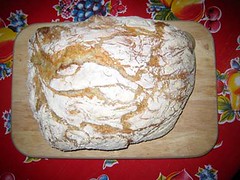
A few loaves have, however, tended to look a little flat, spreading out to maybe 10" wide. I did a little poking on the Internets for a solution, and you really would not believe how many people are talking about and baking this very recipe. It looks like I'm just making a wetter dough by spooning flour into the measuring cup (you get less flour smooshed into the cup) rather than just dipping the measuring cup into the flour bag (squashing a larger quantity of flour into the cup). The solution, of course, is to measure by weight, but I'm not sure I have an accurate scale.

The really cool find, though, is the gazillion-odd pictures you get from Flickr when you search for "No-knead bread". Seriously, every shape and color and defect of bread you could imagine, from mouth-watering perfection to some blobby, vaguely bread-like objects. Is it possible that we're all reading the same recipe? But how totally great that so many people are making time for the ultimate slow food!

Cheers, my bakin' homies.

Monday, January 22, 2007

Universal health care: maybe later?

Today, WaPo's got a piece on the state of the health care debate. To sum up, Washington is starting to figure out what the states already know: somebody's gotta do something to expand coverage, preferably to everybody. But the feds don't have the money or the political will, so until the next election all the action will happen at the state level. And it's completely unnecessary to point out that we're currently investing trillions in Iraq, where the return on our investment is dubious at best. (A couple days ago, NYT offered a helpful graphic that compared the estimated cost of the war to the estimated cost of some crazy social-programmy things like universal health care, which was incredibly depressing, but I can't seem to find the link right now. Good.)

For the last couple days, I've been reading about a plan the president will announce in the SOTU Address tomorrow night. Yesterday's story in WaPo indicates that the plan will be to impose a tax on plans a tax on the value of employer-provided health plans that exceed more than $15,000. The tax would be used to subsidize health plans for those who buy coverage out-of-pocket:
Under the president's proposal, workers who receive employer-provided health insurance would have to pay a tax on the cost of their benefit above $15,000, the threshold proposed by Bush for the tax break. For instance, if a person's health insurance costs $16,000, he would pay a tax on the $1,000 difference.

People with families who buy low-cost policies, meanwhile, would have their taxable income reduced by $15,000, regardless of the cost of the plans and whether they itemize deductions on their tax returns. The deduction would be $7,500 for single individuals. The deduction, to be indexed to account for inflation, would also be extended to those with employer-provided plans, to be offset by the cost of their coverage.

"This is a huge incentive for the uninsured to get coverage, but, also, the vast majority of people with employer-provided coverage will benefit as well," a senior administration official said. "This is essentially a standard deduction for health care, and the size of the deduction will be significantly higher than the cost of an average policy."

The Bush administration estimates that 80 percent of people with employer-provided plans would see their tax liability fall because the deduction would be larger than the value of their insurance plans.

It sounds like a good idea. But it sounds less like a first step to solving the nation's health care problem and more like a first step to doing away with the enormous regressive subsidies in the tax code. Why not do both?

There's no way around it: fixing health care isn't just a matter of redistributing some money, we're going to have to spend more. Trimming all the waste out of the system--the corporate profits, the expensive emergency care that could have been prevented by cheap preventive care, whatever saving you might realize from tort reform--won't be enough to pay for quality care for everybody. One good way to pay for it would be to gradually cap the enormously regressive tax deduction for home mortgage interest.

The house behind ours just happens to be an enormous mansion with lake frontage. It has a garage that's bigger than our house. What public policy is served by allowing my neighbor to deduct every cent of the interest he pays on the mortgage for his mansion?

Sunday, January 21, 2007

Snowing again

We waited, and last weekend, it finally came: snow, 6" or so. It felt, at least for a little while, as though our little blue and green planet was not in fact spinning out of control. Gas prices dropped down to $1.99 per gallon. Two lost boys were found, apparently unharmed. Things got busy at the office, and it made me feel useful and productive to leave a week's worth of crossword puzzles empty, untouched. On Friday, when I left the office, there was still a little purplish-orange glow in the sky.

But here it is again, Sunday morning. It snowed again last night, and it's beautiful to look at. But it's so quiet, just me and the dogs and the hum of the refrigerator and a couple of dusky little juncos at the bird feeder.

Tuesday, January 02, 2007

New year, old problems


In the early morning hours of New Year's Day, I was staying at my dad's house, laying awake, watching the sun rise, and composing a short speech. Here's the gist of the speech, which I delivered to my dad over coffee:

This morning, I laid awake, watching the sun rise and composing a short speech, and here goes: In our live, all of us must learn a very painful lesson, namely that there is no occurrence, no sequence of events, that is so awful that God does not let it happen. If we are fortunate, God allows these things to happen to us while we are with people whom we love. It is in this spirit that I report the following:

Last night, I knocked over my urinal and spilled a generous quantity of urine on the carpeted floor of the room where your 13-year-old daughter usually sleeps.

Other than that, my Xmas vacation was okay.