A number of media outlets (e.g., CBS News) are reporting on a study published today that indicates MS prevalence is up 50% since 1982 to .9 cases per thousand. Are more people getting sick or are more people getting diagnosed? Don't know, but it's starting to seem like there really ought to be at least one charismatic, young A-list celebrity with MS who can do for this disease what Michael J. Fox has done for Parkinson's. Annette Funicello's too old; Squiggy's too old and kinda obscure; Teri Garr's too old and kinda flaky; Montel Williams is close, but still a bit too old (sorry guys, it's strictly business).
What we need is someone who, like Michael J. Fox, has been in the mainstream public eye so pervasively that he or she feels like somebody we all know and grew up with. What are we doing wrong?
Tuesday, January 30, 2007


Wednesday, January 24, 2007
Doing some math on the Bush tax plan
Here's how the Bush tax plan for health insurance works out for me, I think: The total premium for my employer-provided family HMO coverage is $1050 per month (of which I pay $68 per month). If the value of my coverage is computed based on what my employer pays, $982 per month or $11,784 per year, that yields a deduction of $3,216 ($15,000 - $11,784). At our marginal tax rate of 15% (last year, anyway), that means we'll pay about $482 less in taxes than I would have without the deduction.
So that's nice, I guess. But the question I have is, what's the government getting in terms of its stated goal of expanding health coverage for that outlay? Well, I guess it's discouraging the kind of Cadillac plan for which people are going to end up losing some tax deductions. And I guess the argument is that by penalizing the Cadillac plan, we're somehow discouraging the rising cost of health care in the country. So, OK. But as I understand it, the deduction for people like me with Hyundai plans won't be totally offset by the deductions lost by Cadillac people for a number of years. In fact, the only reason the Cadillacs will eventually zero out the Hyundais is because the $15,000 figure won't go up as fast as my Hyundai policy goes up. So eventually, even the Hyundais will end up losing the goodies they'd get early on, and end up being contributors to the tax subsidy (sorta the way families with moderate incomes have been swept up by the alternative minimum tax).
And what about that subsidy? In the beginning, I get a nice little piece of that action, even though it's going to cost the government in the beginning. But eventually, me and fellow Hyundais are going to be kicking in money to subsidize somebody else's tax deduction. The thinking is that the tax subsidy is going to make it possible for somebody who isn't presently covered to get coverage.
I don't think it's a bad idea to quit using the tax code to subsidize Cadillac health coverage, and I don't think it's a bad idea to use the tax code to subsidize Hyundai coverage for people who don't have any. I just think it's another example of too little, too late. There are millions of people without coverage, and many of them aren't going to benefit in a meaningful way from a tax deduction.
For a different take on the Bush plan, check out Ruth Marcus's piece in today's WaPo. And for an interesting peek into Bush's SOTUs, check out NYT's interactive feature that lets you search the text of Bush's SOTUs for keywords. Search for "health" and watch the 6-year evolution of the Bush health policy agenda.
So that's nice, I guess. But the question I have is, what's the government getting in terms of its stated goal of expanding health coverage for that outlay? Well, I guess it's discouraging the kind of Cadillac plan for which people are going to end up losing some tax deductions. And I guess the argument is that by penalizing the Cadillac plan, we're somehow discouraging the rising cost of health care in the country. So, OK. But as I understand it, the deduction for people like me with Hyundai plans won't be totally offset by the deductions lost by Cadillac people for a number of years. In fact, the only reason the Cadillacs will eventually zero out the Hyundais is because the $15,000 figure won't go up as fast as my Hyundai policy goes up. So eventually, even the Hyundais will end up losing the goodies they'd get early on, and end up being contributors to the tax subsidy (sorta the way families with moderate incomes have been swept up by the alternative minimum tax).
And what about that subsidy? In the beginning, I get a nice little piece of that action, even though it's going to cost the government in the beginning. But eventually, me and fellow Hyundais are going to be kicking in money to subsidize somebody else's tax deduction. The thinking is that the tax subsidy is going to make it possible for somebody who isn't presently covered to get coverage.
I don't think it's a bad idea to quit using the tax code to subsidize Cadillac health coverage, and I don't think it's a bad idea to use the tax code to subsidize Hyundai coverage for people who don't have any. I just think it's another example of too little, too late. There are millions of people without coverage, and many of them aren't going to benefit in a meaningful way from a tax deduction.
For a different take on the Bush plan, check out Ruth Marcus's piece in today's WaPo. And for an interesting peek into Bush's SOTUs, check out NYT's interactive feature that lets you search the text of Bush's SOTUs for keywords. Search for "health" and watch the 6-year evolution of the Bush health policy agenda.
Tuesday, January 23, 2007
Bread: It takes a village
For the last six weeks or so, I've been baking two or three loaves of bread a week. It's Mark Bittman's No-Knead Bread recipe, and it's sweeping the nation, or at least the bread-loving segment of the nation. Most of my loaves have come out lovely, with the exception of the loaf I tried to make with the bran-speckled organic stuff my wife brought home. My standard loaf is now Bittman's recipe with the addition of a generous handful of sesame seeds on top. For those of you keeping score at home, I put them on the towel before setting the shaped dough on the towel for the last couple hours.
A few loaves have, however, tended to look a little flat, spreading out to maybe 10" wide. I did a little poking on the Internets for a solution, and you really would not believe how many people are talking about and baking this very recipe. It looks like I'm just making a wetter dough by spooning flour into the measuring cup (you get less flour smooshed into the cup) rather than just dipping the measuring cup into the flour bag (squashing a larger quantity of flour into the cup). The solution, of course, is to measure by weight, but I'm not sure I have an accurate scale.
The really cool find, though, is the gazillion-odd pictures you get from Flickr when you search for "No-knead bread". Seriously, every shape and color and defect of bread you could imagine, from mouth-watering perfection to some blobby, vaguely bread-like objects. Is it possible that we're all reading the same recipe? But how totally great that so many people are making time for the ultimate slow food!
Cheers, my bakin' homies.
A few loaves have, however, tended to look a little flat, spreading out to maybe 10" wide. I did a little poking on the Internets for a solution, and you really would not believe how many people are talking about and baking this very recipe. It looks like I'm just making a wetter dough by spooning flour into the measuring cup (you get less flour smooshed into the cup) rather than just dipping the measuring cup into the flour bag (squashing a larger quantity of flour into the cup). The solution, of course, is to measure by weight, but I'm not sure I have an accurate scale.
The really cool find, though, is the gazillion-odd pictures you get from Flickr when you search for "No-knead bread". Seriously, every shape and color and defect of bread you could imagine, from mouth-watering perfection to some blobby, vaguely bread-like objects. Is it possible that we're all reading the same recipe? But how totally great that so many people are making time for the ultimate slow food!
Cheers, my bakin' homies.
Monday, January 22, 2007
Universal health care: maybe later?
Today, WaPo's got a piece on the state of the health care debate. To sum up, Washington is starting to figure out what the states already know: somebody's gotta do something to expand coverage, preferably to everybody. But the feds don't have the money or the political will, so until the next election all the action will happen at the state level. And it's completely unnecessary to point out that we're currently investing trillions in Iraq, where the return on our investment is dubious at best. (A couple days ago, NYT offered a helpful graphic that compared the estimated cost of the war to the estimated cost of some crazy social-programmy things like universal health care, which was incredibly depressing, but I can't seem to find the link right now. Good.)
For the last couple days, I've been reading about a plan the president will announce in the SOTU Address tomorrow night. Yesterday's story in WaPo indicates that the plan will be to impose a tax on plans a tax on the value of employer-provided health plans that exceed more than $15,000. The tax would be used to subsidize health plans for those who buy coverage out-of-pocket:
It sounds like a good idea. But it sounds less like a first step to solving the nation's health care problem and more like a first step to doing away with the enormous regressive subsidies in the tax code. Why not do both?
There's no way around it: fixing health care isn't just a matter of redistributing some money, we're going to have to spend more. Trimming all the waste out of the system--the corporate profits, the expensive emergency care that could have been prevented by cheap preventive care, whatever saving you might realize from tort reform--won't be enough to pay for quality care for everybody. One good way to pay for it would be to gradually cap the enormously regressive tax deduction for home mortgage interest.
The house behind ours just happens to be an enormous mansion with lake frontage. It has a garage that's bigger than our house. What public policy is served by allowing my neighbor to deduct every cent of the interest he pays on the mortgage for his mansion?
For the last couple days, I've been reading about a plan the president will announce in the SOTU Address tomorrow night. Yesterday's story in WaPo indicates that the plan will be to impose a tax on plans a tax on the value of employer-provided health plans that exceed more than $15,000. The tax would be used to subsidize health plans for those who buy coverage out-of-pocket:
Under the president's proposal, workers who receive employer-provided health insurance would have to pay a tax on the cost of their benefit above $15,000, the threshold proposed by Bush for the tax break. For instance, if a person's health insurance costs $16,000, he would pay a tax on the $1,000 difference.
People with families who buy low-cost policies, meanwhile, would have their taxable income reduced by $15,000, regardless of the cost of the plans and whether they itemize deductions on their tax returns. The deduction would be $7,500 for single individuals. The deduction, to be indexed to account for inflation, would also be extended to those with employer-provided plans, to be offset by the cost of their coverage.
"This is a huge incentive for the uninsured to get coverage, but, also, the vast majority of people with employer-provided coverage will benefit as well," a senior administration official said. "This is essentially a standard deduction for health care, and the size of the deduction will be significantly higher than the cost of an average policy."
The Bush administration estimates that 80 percent of people with employer-provided plans would see their tax liability fall because the deduction would be larger than the value of their insurance plans.
It sounds like a good idea. But it sounds less like a first step to solving the nation's health care problem and more like a first step to doing away with the enormous regressive subsidies in the tax code. Why not do both?
There's no way around it: fixing health care isn't just a matter of redistributing some money, we're going to have to spend more. Trimming all the waste out of the system--the corporate profits, the expensive emergency care that could have been prevented by cheap preventive care, whatever saving you might realize from tort reform--won't be enough to pay for quality care for everybody. One good way to pay for it would be to gradually cap the enormously regressive tax deduction for home mortgage interest.
The house behind ours just happens to be an enormous mansion with lake frontage. It has a garage that's bigger than our house. What public policy is served by allowing my neighbor to deduct every cent of the interest he pays on the mortgage for his mansion?
Sunday, January 21, 2007
Snowing again
We waited, and last weekend, it finally came: snow, 6" or so. It felt, at least for a little while, as though our little blue and green planet was not in fact spinning out of control. Gas prices dropped down to $1.99 per gallon. Two lost boys were found, apparently unharmed. Things got busy at the office, and it made me feel useful and productive to leave a week's worth of crossword puzzles empty, untouched. On Friday, when I left the office, there was still a little purplish-orange glow in the sky.
But here it is again, Sunday morning. It snowed again last night, and it's beautiful to look at. But it's so quiet, just me and the dogs and the hum of the refrigerator and a couple of dusky little juncos at the bird feeder.
But here it is again, Sunday morning. It snowed again last night, and it's beautiful to look at. But it's so quiet, just me and the dogs and the hum of the refrigerator and a couple of dusky little juncos at the bird feeder.
Tuesday, January 02, 2007
New year, old problems

In the early morning hours of New Year's Day, I was staying at my dad's house, laying awake, watching the sun rise, and composing a short speech. Here's the gist of the speech, which I delivered to my dad over coffee:
This morning, I laid awake, watching the sun rise and composing a short speech, and here goes: In our live, all of us must learn a very painful lesson, namely that there is no occurrence, no sequence of events, that is so awful that God does not let it happen. If we are fortunate, God allows these things to happen to us while we are with people whom we love. It is in this spirit that I report the following:
Last night, I knocked over my urinal and spilled a generous quantity of urine on the carpeted floor of the room where your 13-year-old daughter usually sleeps.
Other than that, my Xmas vacation was okay.
Thursday, December 21, 2006
Suggestions for sterner FDA warnings for acetaminophen
"FDA Wants Sterner Pain Reliever Warnings" - AP, 12/20/06
1. Extended use of this product will make your face stay that way.
2. Use as directed or you'll shoot your eye out.
3. Converting this package into a bong is prohibited by federal law.
4. For internal use only; do not insert product into ear or nose.
5. This product is not approved for use by squirrels.
1. Extended use of this product will make your face stay that way.
2. Use as directed or you'll shoot your eye out.
3. Converting this package into a bong is prohibited by federal law.
4. For internal use only; do not insert product into ear or nose.
5. This product is not approved for use by squirrels.
Wednesday, December 20, 2006
Vitamin D may lower MS risk
A study published in JAMA says that white people with the highest blood levels of vitamin D are less likely to develop multiple sclerosis than people with low levels. The study looked at blood samples from 7 million members of the US military. Here's a link to a short piece in the WaPo.
I've been taking a daily vitamin D supplement for maybe a year, in part because I know I don't drink enough milk to get my RDA that way, but also because of some vague half-baked notion that it might help with MS. I know there's no evidence that it could work that way, i.e., that someone who already has MS could be helped by getting more vitamin D. Perhaps this reflects a little sparkle of optimism, some kernel of hope, from a place deep in the brain that is unburdened by logic.
It's easy to let the logical parts of the brain shout down that little sparkle. It's easy to sigh disapprovingly at bee venom, amalgam replacement, laetrile, and any other "therapy" for which there is no proof of effectiveness. It's really, really hard, though, to let yourself believe that things will get better, or even that they might get better.
I've been taking a daily vitamin D supplement for maybe a year, in part because I know I don't drink enough milk to get my RDA that way, but also because of some vague half-baked notion that it might help with MS. I know there's no evidence that it could work that way, i.e., that someone who already has MS could be helped by getting more vitamin D. Perhaps this reflects a little sparkle of optimism, some kernel of hope, from a place deep in the brain that is unburdened by logic.
It's easy to let the logical parts of the brain shout down that little sparkle. It's easy to sigh disapprovingly at bee venom, amalgam replacement, laetrile, and any other "therapy" for which there is no proof of effectiveness. It's really, really hard, though, to let yourself believe that things will get better, or even that they might get better.
Tuesday, December 19, 2006
What's in my grocery cart?
3 boxes (family size) Post Raisin Bran
3 boxes Quaker Corn Bran
4 bags Sunsweet Pitted Prunes
1 16 oz. bag golden raisins
1 8-pack Activia Yogurt (strawberry/blueberry)
2 5-lb. bags King Arthur Bread Flour
1 cucumber (Euro-type)
6 apples (Pink Lady)
3 liter bottles Naleczowianka mineral water (bubbly)
3 Freschetta frozen pizzas (cheese, pepperoni, supreme)
1/2 gal. skim milk (organic)
1 pint half and half (organic)
1 bottle chipotle/cheddar salad dressing
1 4-pack Sioux City birch beer
3 boxes Quaker Corn Bran
4 bags Sunsweet Pitted Prunes
1 16 oz. bag golden raisins
1 8-pack Activia Yogurt (strawberry/blueberry)
2 5-lb. bags King Arthur Bread Flour
1 cucumber (Euro-type)
6 apples (Pink Lady)
3 liter bottles Naleczowianka mineral water (bubbly)
3 Freschetta frozen pizzas (cheese, pepperoni, supreme)
1/2 gal. skim milk (organic)
1 pint half and half (organic)
1 bottle chipotle/cheddar salad dressing
1 4-pack Sioux City birch beer
Friday, December 15, 2006
What's right with our relationship
We've been to see our therapist for a couple of joint sessions, and the really surprising thing is that it's helped us to see how good our relationship is, how our occasional fights really are occasional, and how most of the time, each of us feels great respect for the other and wants to look out for the other. In fact, I was thinking that much of the substance of our next meeting would be devoted to receiving instruction in meditation and mindfulness. I was thinking that until yesterday afternoon, when my wife called me to report that she'd been laid off.
It wasn't a total shock; there had been pretty painful warning signs over the last month, but it still made me want to inflict some sort of awful harm on the people responsible. Fortunately, we'll be fine in terms of finances and health insurance coverage. Some of my wife's colleagues will have a much harder time.
So we may end up spending some time with the therapist trying to sort this out. But it has been somehow comforting to notice how strongly each of us empathizes with the other, how deeply each of us feels the other's hurt, even though research suggests that this kind of empathy is less important to a relationship than our ability to genuinely share our partner's joy.
It wasn't a total shock; there had been pretty painful warning signs over the last month, but it still made me want to inflict some sort of awful harm on the people responsible. Fortunately, we'll be fine in terms of finances and health insurance coverage. Some of my wife's colleagues will have a much harder time.
So we may end up spending some time with the therapist trying to sort this out. But it has been somehow comforting to notice how strongly each of us empathizes with the other, how deeply each of us feels the other's hurt, even though research suggests that this kind of empathy is less important to a relationship than our ability to genuinely share our partner's joy.
Wednesday, December 06, 2006
Crusty nirvana

I spend a lot of time in the kitchen, especially when the weather is cooler and invites warm, savory comfort food (braises, soups, stews, etc.) that pairs well with wine. I've dabbled with bread on and off, with mixed results, but for the last couple years I've been content to buy crusty bread when I had a hankering for it. But a few weeks ago, Mark Bittman's Minimalist column in the NYT offered a simple recipe for satisfying bread with no kneading, relying on a long, slow rise to develop gluten and baking partially inside a heavy pot to produce a hearty crust.
In the last few weeks, I've made maybe a half a dozen loaves of the stuff, and I love it: dense, chewy, with big irregular holes inside and a crisp, thick crust. Today, Bittman's column has some ideas for further refinements, additions, and substitutions. I'm anxious to try a rye version (up to 20% rye flour, plus caraway seeds) and maybe a baguette shape, if I can figure out what to put it in.
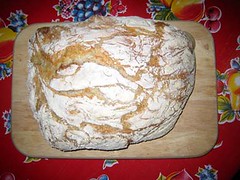
Bittman reports that he prefers to bake in a smaller cast iron pot, maybe 3 or 4 quarts. I started out using an old Magnalite aluminum dutch oven of about that size, but have since decided I prefer to use my big (8-qt?) Calphalon soup pot. I found that in the smaller pot, the bread wouldn't develop much color at all until I took the cover off, and by the time it was finished it wasn't yet that beautiful dark mahogany that I associate with great artisanal bread (I've got a picture of my first loaf, which I'll post when Blogger cooperates). With the bigger pot, the larger volume decreases the concentration of steam that the bread is exposed to for the first half hour.
My favorite thing about the bread is that it's just as good toasted a few days after baking as it was right out of the oven.
Tuesday, December 05, 2006
What's a defect?
Today's NYT has a short essay on a journal article on parents using preimplantation genetics to ensure that their offspring, like them, express genetic traits like deafness or dwarfism. Usually, the technique is used to prevent the transmission of diseases like CF and Huntington's, but a survey of 190 fertility clinics indicated that 3% had used the technique to select for a disability. Snip:
This really seems to cut to the heart of what it means to be disabled. In the case of deafness and dwarfism, there seems to be a culture that comes along with the physical difference such that those who have access to that culture (and perhaps not to elements of the larger culture that are available to the able) desire to share the culture with offspring.
It seems pretty obvious that MS lacks a culture of its own. Our physical differences are often undetectable, and move among the larger culture even though we may be able to take part in it fully. Given the prevalence of MS, we may encounter others with the same illness without even knowing it. If there is an MS culture, it probably exists only on the net; that's the only place where we're likely to encounter each other as members of the same gimpy tribe.
In other words, some parents had the painful and expensive fertility procedure for the express purpose of having children with a defective gene. It turns out that some mothers and fathers don’t view certain genetic conditions as disabilities but as a way to enter into a rich, shared culture.
It’s tempting to see this practice as an alarming trend; for example, the online magazine Slate called it “the deliberate crippling of children.” Dr. Robert J. Stillman of the Shady Grove Fertility Center in Rockville, Md., has denied requests to use the process for selecting deafness and dwarfism. “In general, one of the prime dictates of parenting is to make a better world for our children,” he said in an interview. “Dwarfism and deafness are not the norm.” Dr. Yury Verlinsky of the Reproductive Genetics Institute in Chicago, who also refuses these requests, said, “If we make a diagnostic tool, the purpose is to avoid disease.” But both doctors said they would not oppose sending families to other doctors who might consent.
This really seems to cut to the heart of what it means to be disabled. In the case of deafness and dwarfism, there seems to be a culture that comes along with the physical difference such that those who have access to that culture (and perhaps not to elements of the larger culture that are available to the able) desire to share the culture with offspring.
It seems pretty obvious that MS lacks a culture of its own. Our physical differences are often undetectable, and move among the larger culture even though we may be able to take part in it fully. Given the prevalence of MS, we may encounter others with the same illness without even knowing it. If there is an MS culture, it probably exists only on the net; that's the only place where we're likely to encounter each other as members of the same gimpy tribe.
Monday, December 04, 2006
An investment of a sort
Tonight, she and I will be returning for a dual session with the therapist. We have, more than a few times, buried the hatchet in whatever conflict happened to make one or both of us furious and sworn that we really ought to see someone, i.e., marriage counselor, but we never really got anywhere until recently. The problem is that our insurance doesn't pay for family issues, so the question was: If we're going to pay out of pocket, who do we want to see? She managed to get a recommendation from a coworker for a guy who has some experience with MS couples, so we went last Monday for a session.
Of course, the first session doesn't really go anywhere, mostly just getting-to-know-you-and-your-marital-issues. I think C. even surprised herself when she was in tears after the first question, to wit: "So what do you hope to get out of counseling?" She went first, saying something about some suggestions for managing conflict, which went fine, but then I said something about how I wasn't really expecting to get advice, but just an opportunity to talk thru some things, especially since I really don't have many (any?) close relationships in which I'd feel comfortable bringing up marital stuff. And that was enough.
See, my wife has this extraordinary capacity for empathy, and what I said was enough to make her feel, all at once, all of the sudden, the isolation and loneliness that I've often felt not just with MS but even before as a guy who perceives himself to lack great social skills. And I sorta sat there for a while thinking about how it felt to feel her feel my pain. (The therapist seems to like to interact with one person at a time, leaving the other to listen and think.) Anyway, it seemed like we were done pretty quickly, and just that brief experience I think gave us enough empathy to have a week in which we really enjoyed each other's company.
But there is the small matter of the fee: $120 for an hour, which ain't exactly pocket change. For a couple days afterward, we talked about whether we felt like it was worth $120 an hour to go back for more sessions in the future. As an avowed cheapskate, I felt like maybe we could have found someone better, even though we'd only been to see this guy once. C. agreed that $120 would multiply rapidly, especially if it turned out that we wanted to keep coming back. So I called and left the therapist a message saying that we liked him but we didn't feel like we could afford his services, that we'd probably try to see therapists covered by our insurance on an individual basis, etc., etc. I was a little surprised when he called me back to so that he could offer us a discount, that he thought we would really benefit from couples work, etc., etc.
So we're going back tonite.
Of course, the first session doesn't really go anywhere, mostly just getting-to-know-you-and-your-marital-issues. I think C. even surprised herself when she was in tears after the first question, to wit: "So what do you hope to get out of counseling?" She went first, saying something about some suggestions for managing conflict, which went fine, but then I said something about how I wasn't really expecting to get advice, but just an opportunity to talk thru some things, especially since I really don't have many (any?) close relationships in which I'd feel comfortable bringing up marital stuff. And that was enough.
See, my wife has this extraordinary capacity for empathy, and what I said was enough to make her feel, all at once, all of the sudden, the isolation and loneliness that I've often felt not just with MS but even before as a guy who perceives himself to lack great social skills. And I sorta sat there for a while thinking about how it felt to feel her feel my pain. (The therapist seems to like to interact with one person at a time, leaving the other to listen and think.) Anyway, it seemed like we were done pretty quickly, and just that brief experience I think gave us enough empathy to have a week in which we really enjoyed each other's company.
But there is the small matter of the fee: $120 for an hour, which ain't exactly pocket change. For a couple days afterward, we talked about whether we felt like it was worth $120 an hour to go back for more sessions in the future. As an avowed cheapskate, I felt like maybe we could have found someone better, even though we'd only been to see this guy once. C. agreed that $120 would multiply rapidly, especially if it turned out that we wanted to keep coming back. So I called and left the therapist a message saying that we liked him but we didn't feel like we could afford his services, that we'd probably try to see therapists covered by our insurance on an individual basis, etc., etc. I was a little surprised when he called me back to so that he could offer us a discount, that he thought we would really benefit from couples work, etc., etc.
So we're going back tonite.
Friday, December 01, 2006
Is there a place for carrots and/or sticks in Medicaid?
Interesting piece in NYT on a West Virginia pilot program that will reward Medicaid beneficiaries who are "responsible patients" and deny some services to those who do not join weight-loss or antismoking programs, or who miss too many appointments. Snip:
I don't know if I like this or not. On one hand, I'm sympathetic to the NEJ's concerns about denying medical services on the basis of something that's beyond their reasonable control. On the other hand, there's John Johnson. Snip:
We're all paying for John Johnsons, both in Medicaid and in our HMOs and other insurance pools. And sure it's galling to have to pay for health services for a guy who doesn't care enough about his health to change obviously unhealthy behaviors. But I'm uncomfortable with giving the government a stick in this situation. It's not clear from the article to what extent the program involves the stick approach, but from a structural perspectice, the use of a stick requires a lot more due process protection to ensure only those who are truly stick-worthy get stuck. I'm much more comfortable with a carrot approach: if a beaurocracy makes a mistake in handing out carrots, nobody gets hurt. People might not get a carrot they're entitled to, but nobody gets hurt. And from a behavior-modification standpoint, doesn't science teach us that carrots reinforce good behavior much more effectively than sticks prevent bad behavior?
Those signing and abiding by the agreement (or their children, who account for a majority of Medicaid patients here) will receive “enhanced benefits” including mental health counseling, long-term diabetes management and cardiac rehabilitation, and prescription drugs and home health visits as needed, as well as antismoking and antiobesity classes. Those who do not sign will get federally required basic services but be limited to four prescriptions a month, for example, and will not receive the other enhanced benefits.
....
No one questions that West Virginia, more than most other states, needs more healthful lifestyles and better primary and preventive care. But the new plan has stirred national debate about its fairness and medical ethics. A stinging editorial in The New England Journal of Medicine on Aug. 24 said it could punish patients for factors beyond their control, like lack of transportation; would penalize children for errors of their parents; would hold Medicaid patients to standards of compliance that are often not met by middle-class people; and would put doctors in untenable positions as enforcers.
“What if everyone at a major corporation were told they would lose benefits if they didn’t lose weight or drink less?” said a co-author of the editorial, Dr. Gene Bishop, a physician at Pennsylvania Hospital in Philadelphia.
I don't know if I like this or not. On one hand, I'm sympathetic to the NEJ's concerns about denying medical services on the basis of something that's beyond their reasonable control. On the other hand, there's John Johnson. Snip:
Speaking from the easy chair where he spends his days in a small wooden house near this small Appalachian town, his left trouser leg folded by a safety pin where a limb was lost to diabetes, he lighted another cigarette. Mr. Johnson, 61 and a former garbage collector, takes insulin and goes to a clinic once a month for diabetes checkups. Taxpayers foot the bill through Medicaid, the federal-state health coverage program for the poor. But when doctors urged him to mind his diet, “I told them I eat what I want to eat and the hell with them. I’ve been smoking for 50 years — why should I stop now?” he added for good measure. “This is supposed to be a free world.”
We're all paying for John Johnsons, both in Medicaid and in our HMOs and other insurance pools. And sure it's galling to have to pay for health services for a guy who doesn't care enough about his health to change obviously unhealthy behaviors. But I'm uncomfortable with giving the government a stick in this situation. It's not clear from the article to what extent the program involves the stick approach, but from a structural perspectice, the use of a stick requires a lot more due process protection to ensure only those who are truly stick-worthy get stuck. I'm much more comfortable with a carrot approach: if a beaurocracy makes a mistake in handing out carrots, nobody gets hurt. People might not get a carrot they're entitled to, but nobody gets hurt. And from a behavior-modification standpoint, doesn't science teach us that carrots reinforce good behavior much more effectively than sticks prevent bad behavior?
Thursday, November 30, 2006
North Korea: Puzzling, fascinating

I'm probably not the only person who's curious about North Korea. Not just because of the news, but also because the gradual Wal-Martification of the rest of the world has made North Korea seem that much weirder. I recently read Guy Delisle's nifty Pyongyang, a graphic novel recounting the author's experiences working there, and today, Slate's "Today's Pictures" has a few tantalizing shots from North Korea. If you search on "Pyongyang" at Flickr, you can see some more glimpses into this frighteningly odd society.
Consumer-directed health plans: early reviews mixed
WaPo has an article about a study of people enrolled in so-called consumer-directed health plans. Basically, we're talking about people who are enrolled in high-deductible, low-premium health insurance plans and who pay their share of health costs with pre-tax money from health savings accounts.
According to the study, these folks are indeed paying more attention to their cost of care, just as advocates for such plans predicted. On the other hand, they tend to be healthier, whiter, and richer than those who in traditional plans, just as critics predicted. Bottom line: half of those in consumer-directed plans would switch to a traditional plan if they could; about a third of those in traditional plans say they would switch to consumer-directed plans. Snip:
Link.
According to the study, these folks are indeed paying more attention to their cost of care, just as advocates for such plans predicted. On the other hand, they tend to be healthier, whiter, and richer than those who in traditional plans, just as critics predicted. Bottom line: half of those in consumer-directed plans would switch to a traditional plan if they could; about a third of those in traditional plans say they would switch to consumer-directed plans. Snip:
In contrast with other plans that typically require $15 or $20 co-payments for visits to the doctor, the new plans can require consumers to shell out hundreds or thousands of dollars of their own money for medications, physicians' services and hospital care before most coverage kicks in. The plans have high annual deductibles, but their premiums tend to be lower.
....
"It's a cultural shift," said Devon Herrick, a health economist at the National Center for Policy Analysis in Dallas. "When you go to Wal-Mart you don't have to ask about price -- it's right there next to the good or service you are buying. Health care is not there yet, but it's getting that way. This is the early stages. We have the incentives to get people more responsible and asking about price."
Link.
Tuesday, November 28, 2006
Young man, don't sit up straight
Interesting item in the ChiTrib today about sitting and posture. Turns out that sitting up straight, with your back at a 90-degree angle to the floor, is more likely to lead to back pain than leaning back. Specifically, a 135-degree angle is ideal. In fact, that big-ass recliner in front of the TV would be perfect, if you could get it into your cubicle. Snip:
Link.
"Really the best position is what you get in a La-Z-Boy, although that wouldn't work well for someone using a computer," said Dr. Waseem Amir Bashir, who led a study conducted at Woodend Hospital in Aberdeen, Scotland.
Bashir's findings, which confirm what experts in ergonomics have believed, were presented at the McCormick Place meeting of the Radiological Society of North America. His conclusions come from getting a different view of the spine, using a newly designed magnetic resonance imaging machine that allows for a full view of the back while sitting.
....
Assuming any position for a long period is a bad practice, said Judy Lesse, an ergonomics consultant for Herman Miller. "We design our chairs so that people can change positions regularly," she said. "You may find it difficult to lean back while using a computer, but you can lean back while talking on the phone."
Dave Trippany, corporate ergonomist for Steelcase Inc., a Grand Rapids, Mich., maker of office furniture, said that "flexibility is the key. People should move around to increase circulation. Reclining is part of that."
Link.
Monday, November 27, 2006
Anti-inflammatory plant stuff
This morning's WaPo has a gee-whiz article about research into the anti-inflammtory properties of a plant from the ginger family called Afromomum melagueta. In the wild, gorillas have apparently long been savvy to this stuff's benefits, but unfortunately lacked the marketing skills to properly exploit its commercial potential. Thank goodness Avon got ahold of some; it plans to market skin-care products containing Afromomum. Others speculate about its use as a substitute for anti-inflammatory pharmaceuticals like Vioxx and Bextra. Snip:
Link.
A clear vial filled with amber fluid rests on scientist Ilya Raskin's desk, glinting in the autumn sunlight streaming through his office window. The container, a small glass bottle with a plain white screw-top, contains a substance Raskin calls 006. "Double-zero-six" is potentially more precious than the rarest topaz.
Raskin is a biochemist at Rutgers University's Biotechnology Center. The golden liquid on his desk may prove to be one of the most powerful anti-inflammatory substances ever discovered. "It contains a derivative of a plant known as grains of paradise, or Aframomum melegueta, a member of the ginger family," said Raskin. The compound works in a similar way to the well-known anti-inflammatory drugs Vioxx, Celebrex and Bextra but, it is hoped, without their side effects, said Raskin and other scientists.
Link.
Wednesday, November 22, 2006
Stupid brain tricks
As a person whose brain is kinda, well, broken, I sometimes lose sight of what a wacky gizmo the brain is. Frinstance, there's a little article in the NYT about a rare condition called lexical-gustatory synaesthesia, in which the brain tastes words. Snip:
So let's give thanks for brains, even broken brains, for connecting us with the world. Hold the ear wax.
One subject, Dr. Simner said, hates driving, because the road signs flood his mouth with everything from pistachio ice cream to ear wax. And Dr. Simner has yet to figure out any logical pattern. For example, the word “mince” makes one subject taste mincemeat, but so do rhymes like “prince.” Words with a soft “g,” as in “roger” or “edge,” make him taste sausage. But another subject, hearing “castanets,” tastes tuna fish. Another can taste only proper names: John is his cornbread, William his potatoes.
So let's give thanks for brains, even broken brains, for connecting us with the world. Hold the ear wax.
Thursday, November 16, 2006
Is this anything? I don't think so.
I've seen a few articles on this particular "story" since Monday or so: the nation's leasing health insurance trade group has come out with a "plan" for covering the millions of Americans who lack health insurance. Snip from a Chicago Trib article:
Is it just me, or is everything in the insurance industry's courageous proposal completely consistent with the industry's interests? It's kinda like the auto industry calling for all Americans to have access to a car.
The articles I've seen characterize the industry's release as a sharp counterpoint to the Harry-and-Louise ads that tanked the Clinton plan a dozen years ago. I could never figure out why it was that the industry opposed the Clinton plan. If I remember right, the plan would have essentially pushed for more employers to offer coverage to their employees, meaning it would have pushed more customers into the waiting arms of the insurance industry.
The only thing that seems not obviously in the industry's interest is the expansion of Medicare and Medicaid. But even there, the industry stands to reap a substantial benefit: more sick people get access to care before they get so sick that they end up in the ER. Right now, the compulsory ER "charity care" is paid for by jacking up the charges to those who have coverage. If you can stop or at least slow down the stampede of poor people through the ER, you can slow down the growth in premiums that's led so many employers (and some employees) to drop their health coverage.
Wake me up when the insurance industry puts out the press release explaining how to pay for the expansion in coverage.
The organization called on the federal government to spend an additional $300 billion over 10 years to expand public health programs for poor Americans, offer subsidies to working families to buy medical coverage, and support state health reform efforts. But there are no specifics on how the proposals would be financed or provisions for taming rapidly escalating costs.
The first priority should be providing insurance protection to almost all of the nation's children in three years, Ignagni said. Then the focus should turn to programs that will aid adults, including new tax-advantaged accounts for people who purchase insurance on their own.
With the Democrats taking charge of Congress after last week's elections, the industry plan helps set the stage for action on health reform. Democrats have long considered health care a priority and signaled a keen interest in expanding medical coverage.
Is it just me, or is everything in the insurance industry's courageous proposal completely consistent with the industry's interests? It's kinda like the auto industry calling for all Americans to have access to a car.
The articles I've seen characterize the industry's release as a sharp counterpoint to the Harry-and-Louise ads that tanked the Clinton plan a dozen years ago. I could never figure out why it was that the industry opposed the Clinton plan. If I remember right, the plan would have essentially pushed for more employers to offer coverage to their employees, meaning it would have pushed more customers into the waiting arms of the insurance industry.
The only thing that seems not obviously in the industry's interest is the expansion of Medicare and Medicaid. But even there, the industry stands to reap a substantial benefit: more sick people get access to care before they get so sick that they end up in the ER. Right now, the compulsory ER "charity care" is paid for by jacking up the charges to those who have coverage. If you can stop or at least slow down the stampede of poor people through the ER, you can slow down the growth in premiums that's led so many employers (and some employees) to drop their health coverage.
Wake me up when the insurance industry puts out the press release explaining how to pay for the expansion in coverage.
Subscribe to:
Posts (Atom)