Friday, July 29, 2005
Frist: Cell, yes.
Interesting to see that senator/physician Bill Frist has veered from the social-conservative script and spoken in favor of expanding federal funding for stem-cell research. I'm pleased, because Frist's support is important, and may lead to a change in federal policy on the issue. Nevertheless, it sure smells like an effort by a man with presidential ambitions to move toward the center. Will this redeem the man for his role in the Terry Schiavo circus? Probably not.


New research confirms: MS sucks
I compulsively query the Pub Med database for the latest on MS. Almost every day, really. A new study about the effect of stress on MS finds that
the relationship between life stress and relapse is complex, and is likely to depend on factors such as stressor chronicity, frequency, severity and type, and individual patient characteristics such as depression, health locus of control and coping strategy use. Little is known about how these factors, individually or in combination, are related to MS disease activity. Viral infections are also likely to precipitate relapse in MS, and significant life-stress may further enhance this relationship. The nature and strength of these interrelationships have strong clinical implications. MS patients are particularly vulnerable to a deteriorating cycle of stressful life events, illness episodes and disability. Timely multidisciplinary care interventions aimed at both minimizing psychological distress and physical symptoms may halt this downward reciprocal cycle.
As people with MS already know, the connection between MS and stress isn't just about what happens in the brain that might allow stress to trigger a relapse. It's about what happens in the life of an MS patient: stress triggers relapse and disability; disability triggers stressful life changes (job loss, relationship difficulties, depression); stress triggers another relapse and disability. It's a deteriorating cycle.
The tricky part is getting "timely multidisciplinary care interventions." I don't think there's a practitioner involved in my treatment who is tasked with coordinating multidisciplinary care. I don't think it's my primary care doc; I see him maybe once or twice a year. I think it's up to me: I'm the only person who's in a position to provide the information to each practitioner about what's going on with the others. I'm comfortable with this kind of self-advocacy, and I think I'm doing an okay job. But I don't have any medical expertise, and my ability to advocate for myself may be compromised at a time when I'm most in need of multi-disciplinary care interventions.
Whose job is this?
Thursday, July 28, 2005
Home improvement
For three years, we've been living in a 1960s ranch house in an older 'burb. The house has been subjected to a number of modifications over the years, some useful, and others unfortunate. One of the unfortunate ones is the three-season porch stuck "lean-to" style on the back side of the house, off the kitchen. Structurally, the thing's rotting badly, having been built below grade. Aesthetically, it cuts off most of the light and all of of the view on that side of the house. And it's just plain ugly.
We finally called up a remodeling contractor recommended by a coworker to discuss some options. We'd like to add a screen porch/deck thing, plus a bunch of windows. I'd got a bunch of books from the library, and scouted some architecture/design sites on the web, and had a head full of nifty ideas. The meeting went well: we talked about some ideas for adding a semi-covered deck area out back, and the contractor will do some sketches and some estimates.
The question is, how do we account for my present level of disability and the possibility that I'll become more disabled in the future? We mentioned to the contractor, in a general sort of way, that we were interested in trying to design something that would be relatively barrier-free. That seemed doable: eliminate the step-down to the porch, wide, doors, etc. But that's only part of the puzzle.
The fact is that if I were to stop working, we might not be able to afford the project. Heck, if I got laid up that badly, we'd need to make the bedroom and bathroom accessible, never mind adding something new. Even if we could afford it, I wonder if we'd be able to get a home equity loan without me working. Is it smart to add to our debt load now?
At the bottom of all this is the question of my continued participation in the work force. How much longer will I be working full-time? How do I decide? Will someone decide for me?
Tomorrow morning: gall bladder ultrasound.
We finally called up a remodeling contractor recommended by a coworker to discuss some options. We'd like to add a screen porch/deck thing, plus a bunch of windows. I'd got a bunch of books from the library, and scouted some architecture/design sites on the web, and had a head full of nifty ideas. The meeting went well: we talked about some ideas for adding a semi-covered deck area out back, and the contractor will do some sketches and some estimates.
The question is, how do we account for my present level of disability and the possibility that I'll become more disabled in the future? We mentioned to the contractor, in a general sort of way, that we were interested in trying to design something that would be relatively barrier-free. That seemed doable: eliminate the step-down to the porch, wide, doors, etc. But that's only part of the puzzle.
The fact is that if I were to stop working, we might not be able to afford the project. Heck, if I got laid up that badly, we'd need to make the bedroom and bathroom accessible, never mind adding something new. Even if we could afford it, I wonder if we'd be able to get a home equity loan without me working. Is it smart to add to our debt load now?
At the bottom of all this is the question of my continued participation in the work force. How much longer will I be working full-time? How do I decide? Will someone decide for me?
Tomorrow morning: gall bladder ultrasound.
Thursday, July 21, 2005
Ow, quit it. Ow, quit it. Ow, quit it.
I saw a pain specialist the other day. For the last four years or so, I've had this burning pain down the backs of my legs, and I've tried a lot of different things to get relief. So far, I haven't had much luck.
The pain doc says that MS pain is pretty common--maybe 40% of MS patients experience pain as a result of MS. It's not well understood, though, and medical science-types have really only been paying attention for the last ten years or so.
I've been through the first-line drugs: certain older antidepressants and anticovulsants. The antidepressants didn't really do anything for me, and the anticonvulsants made me feel so dopey that I quit 'em. For the last few years, I've been taking Neurontin, that Swiss Army Knife for the brain. I take quite a bit: one 600 mg pill every two or three hours during the day. It doesn't make me as dopey as old-fashioned carbamazepine did, but I'm still at about a 4 on the pain scale right now. I've tried non-drug stuff, too: I tried accupuncture, which didn't help, and I've been doing yoga, which does help.
Anyhow, I'm optimistic about the pain doc. He's a very nice guy, and seems highly regarded as a clinician. He's recommended a new drug: Cymbalta, a newish antidepressant. (What's with the name? The drug companies are apparently naming their products by opening the dictionary to a random page, pointing at a word, and adding a vowel. Cymbalta? Molari? Drywallo? Toiletta?) Apparently, it shows great promise for reducing neuropathic pain. He also noted that Marinol was a possibility. Unfortunately, my employer's pharmacy benefit manager seems to feel that Cymbalta should cost me more than the stuff I've already tried. I'm told I should send an appeal letter. That should be fun.
The pain doc says that MS pain is pretty common--maybe 40% of MS patients experience pain as a result of MS. It's not well understood, though, and medical science-types have really only been paying attention for the last ten years or so.
I've been through the first-line drugs: certain older antidepressants and anticovulsants. The antidepressants didn't really do anything for me, and the anticonvulsants made me feel so dopey that I quit 'em. For the last few years, I've been taking Neurontin, that Swiss Army Knife for the brain. I take quite a bit: one 600 mg pill every two or three hours during the day. It doesn't make me as dopey as old-fashioned carbamazepine did, but I'm still at about a 4 on the pain scale right now. I've tried non-drug stuff, too: I tried accupuncture, which didn't help, and I've been doing yoga, which does help.
Anyhow, I'm optimistic about the pain doc. He's a very nice guy, and seems highly regarded as a clinician. He's recommended a new drug: Cymbalta, a newish antidepressant. (What's with the name? The drug companies are apparently naming their products by opening the dictionary to a random page, pointing at a word, and adding a vowel. Cymbalta? Molari? Drywallo? Toiletta?) Apparently, it shows great promise for reducing neuropathic pain. He also noted that Marinol was a possibility. Unfortunately, my employer's pharmacy benefit manager seems to feel that Cymbalta should cost me more than the stuff I've already tried. I'm told I should send an appeal letter. That should be fun.
Monday, July 18, 2005
How to freak out your father-in-law
It was terribly hot over the weekend. Nevertheless, on Saturday morning my father-in-law and I set out to do a little fishing. Not much luck, but just enough to keep us in the boat until 11:00 am or so, by which time it had reached a sunny, windless 90 degrees. I could tell that my goose was getting cooked. By 9:30 or so, I was feeling pretty tippy. When we got to the landing, I couldn't walk, so Les had to fetch the car. While he was gone, I peed in my shorts.
Instead of pulling the boat onto the trailer from the dock, I got in the water, and pulled myself along the dock toward the shore, attempting to appear as though I was assisting in the get-out process, when, in fact, I was merely trying to move under my own power. I couldn't even get to the winch, so Les winched the boat onto the trailer. After he pulled the boat up on shore, I managed to buckle one of the transom straps, and then lurched my way up to the car, still dripping wet. There was an old guy at the landing watching the whole thing.
Les is an awfully nice father-in-law, and a stand-up guy in generaly. I wonder what the hell he must have been thinking as we drove back to the house. After stumbling past my mother-in-law and sister-in-law to the shower for a cool soak, I bounced back pretty quickly. That must have helped.
Last night, I talked about the incident with Caryn. I said, You know, if you ever feel like it, you have my permission to freak out. You have equal freaking out rights. She thanked me and said, basically, I don't care about your body, I love you for your mind. So I hope I can hang onto that.
On a completely unrelated topic, this morning, I wasted an hour trying to determine whether I was suffering from a gallbladder problem (gas, bloating, abdominal pain: yep, gallstones). But Dr. M. is out until tomorrow.
Instead of pulling the boat onto the trailer from the dock, I got in the water, and pulled myself along the dock toward the shore, attempting to appear as though I was assisting in the get-out process, when, in fact, I was merely trying to move under my own power. I couldn't even get to the winch, so Les winched the boat onto the trailer. After he pulled the boat up on shore, I managed to buckle one of the transom straps, and then lurched my way up to the car, still dripping wet. There was an old guy at the landing watching the whole thing.
Les is an awfully nice father-in-law, and a stand-up guy in generaly. I wonder what the hell he must have been thinking as we drove back to the house. After stumbling past my mother-in-law and sister-in-law to the shower for a cool soak, I bounced back pretty quickly. That must have helped.
Last night, I talked about the incident with Caryn. I said, You know, if you ever feel like it, you have my permission to freak out. You have equal freaking out rights. She thanked me and said, basically, I don't care about your body, I love you for your mind. So I hope I can hang onto that.
On a completely unrelated topic, this morning, I wasted an hour trying to determine whether I was suffering from a gallbladder problem (gas, bloating, abdominal pain: yep, gallstones). But Dr. M. is out until tomorrow.
Friday, July 15, 2005
I hate the earth's sun
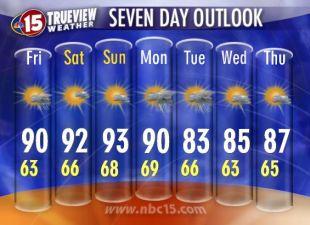
Check out this weekend's forecast. This is the sort of forecast that means I'll be spending the weekend indoors, preferably in the basement, because if I spend more than ten minutes outside I will lose all muscular coordination and collapse into a puddle of warm, quivering, white-guy-flavored Jell-o. Not that I don't have things to do indoors, but it just so happens that my in-laws will be in town this weekend and I usually feel the need to get out of the house from time to time when they're visiting. They're lovely people, very helpful and all that, but, well, you know.
Glad to see the weather will be beautiful on Monday.
Friday, July 08, 2005
Holiday weekend
I spent the weekend of the Fourth with my in-laws, lovely people who live way out at the western edge of Minnesota, two exits from South Dakota. Just outside of their little town is a nifty little state park called Blue Mounds, which is about the only interesting thing around for a hundred miles or so (unless you think Sioux Falls, SD is an interesting thing).
In the twelve or so years I've been making the trip out there, I've always looked forward to going out to the Mounds for a tramp or drive-through or whatever. In an area where it seems like every last acre is either cultivated or shat on by pigs, the Mounds are an oasis of trees and rocks and water and critters of various kinds. It used to be we'd go for a long walk: hopping from rock to rock in the valley where the stream widens out, swatting flies near the little lake, spying patches of cannabis growing on the hillside. The walks have gotten shorter in the last few years, maybe a chilly loop through the campground after Thanksgiving dinner.
This past weekend, the weather out there was drop-dead gorgeous. 82 degrees, sunny, no humidity, cool at night. I slept well, caught up on rest after a few weeks of extended work hours. I was feeling just good enough to do something stupid, like take the dog for a walk at the Mounds in the blazing sun.
I only went about 300 yards from the parking lot. Just after crossing the dyke at the end of the lake, there's a nice little bench, which is where I decided to turn around. By then, though, I was teetering pretty good. I'd dunked a white tee in the lake and put it back on, and wrapped a towel around my head. But by the time I got to crossing the dam on the way back, I worried that I might somehow slip and fall down the side.
There were some kids on the beach back by the parking lot, and I thought for sure they must have been watching me, thinking me a drunk or a lunatic. Crossing the dyke, I had to stop a few times in the course of about fifty yards, kneeling on the hot concrete next to my dog. She was looking anxious and confused, and I was getting worried and embarrassed. Would I need to call out for help?
After I made it across the dyke, I still had to go another hundred yards or so down the asphalt nature trail back to the car. My left leg had all but quit on me. This last bit took me maybe a half hour. I'd walk ten steps, and then stumble forward onto my hands on the hot asphalt. After a couple times, I started trying to cushion myself with the towel, which quickly got all full of gravel. I was afraid I would fall on top of the dog.
As I got closer, inching up an incline in the path, I could hear the people at the beach, kids and adults. I thought I heard them talking about me: What the hell's the deal with that guy? I had to pee, and took a leak in the middle of the nature trail, wizzing all over myself in the process. I got bit by several mosquitos.
When I finally made it to a patch of shady grass at the edge of the parking lot, I laid down on my back and stroked the dog. The car was all of 20 feet away, but after ten steps, I dropped to the ground again. Finally I made it to the car, propped myself against the tailgate, while and fished out my keys. I got the door open, but my arthritic dog wouldn't jump into the car. I sat back down on the ground. The dog laid down. After a rest, I tried, as gently as I could, to boost her into the back, and hobbled to the front seat. I turned on the car, and blasted the A/C.
The next day, I didn't feel too bad, but the following day (yesterday) and today I've been feeling pretty craptacular. When I get burnt out on my feet, I start using my back to hoist my legs along, so my lower back is angry with me. My shins are quite sore, too. Again, some kind of weird body mechanics that engage when I'm pooped. This is a familiar cycle for me: feeling better and then doing something that makes me feel like crap again.
When we left the in-laws, I grabbed the crude walking-stick-shaped gizmo I found in the garage. My father-in-law used to use it to prop up the tailgate on his minivan after the air-spring thing gave out. Now, it's in my living room. I grabbed it on my way out the door to let the dogs out this morning. Am I going to be taking it (or something slightly more refined) to work with me soon?
In the twelve or so years I've been making the trip out there, I've always looked forward to going out to the Mounds for a tramp or drive-through or whatever. In an area where it seems like every last acre is either cultivated or shat on by pigs, the Mounds are an oasis of trees and rocks and water and critters of various kinds. It used to be we'd go for a long walk: hopping from rock to rock in the valley where the stream widens out, swatting flies near the little lake, spying patches of cannabis growing on the hillside. The walks have gotten shorter in the last few years, maybe a chilly loop through the campground after Thanksgiving dinner.
This past weekend, the weather out there was drop-dead gorgeous. 82 degrees, sunny, no humidity, cool at night. I slept well, caught up on rest after a few weeks of extended work hours. I was feeling just good enough to do something stupid, like take the dog for a walk at the Mounds in the blazing sun.
I only went about 300 yards from the parking lot. Just after crossing the dyke at the end of the lake, there's a nice little bench, which is where I decided to turn around. By then, though, I was teetering pretty good. I'd dunked a white tee in the lake and put it back on, and wrapped a towel around my head. But by the time I got to crossing the dam on the way back, I worried that I might somehow slip and fall down the side.
There were some kids on the beach back by the parking lot, and I thought for sure they must have been watching me, thinking me a drunk or a lunatic. Crossing the dyke, I had to stop a few times in the course of about fifty yards, kneeling on the hot concrete next to my dog. She was looking anxious and confused, and I was getting worried and embarrassed. Would I need to call out for help?
After I made it across the dyke, I still had to go another hundred yards or so down the asphalt nature trail back to the car. My left leg had all but quit on me. This last bit took me maybe a half hour. I'd walk ten steps, and then stumble forward onto my hands on the hot asphalt. After a couple times, I started trying to cushion myself with the towel, which quickly got all full of gravel. I was afraid I would fall on top of the dog.
As I got closer, inching up an incline in the path, I could hear the people at the beach, kids and adults. I thought I heard them talking about me: What the hell's the deal with that guy? I had to pee, and took a leak in the middle of the nature trail, wizzing all over myself in the process. I got bit by several mosquitos.
When I finally made it to a patch of shady grass at the edge of the parking lot, I laid down on my back and stroked the dog. The car was all of 20 feet away, but after ten steps, I dropped to the ground again. Finally I made it to the car, propped myself against the tailgate, while and fished out my keys. I got the door open, but my arthritic dog wouldn't jump into the car. I sat back down on the ground. The dog laid down. After a rest, I tried, as gently as I could, to boost her into the back, and hobbled to the front seat. I turned on the car, and blasted the A/C.
The next day, I didn't feel too bad, but the following day (yesterday) and today I've been feeling pretty craptacular. When I get burnt out on my feet, I start using my back to hoist my legs along, so my lower back is angry with me. My shins are quite sore, too. Again, some kind of weird body mechanics that engage when I'm pooped. This is a familiar cycle for me: feeling better and then doing something that makes me feel like crap again.
When we left the in-laws, I grabbed the crude walking-stick-shaped gizmo I found in the garage. My father-in-law used to use it to prop up the tailgate on his minivan after the air-spring thing gave out. Now, it's in my living room. I grabbed it on my way out the door to let the dogs out this morning. Am I going to be taking it (or something slightly more refined) to work with me soon?
Friday, July 01, 2005
Unfortunately, Canada appears not to be an option for me
Like the second Bush election, the O'Connor retirement has me thinking about whether I'm living in the right country. The obvious option is Canada. It's close, friendly, and has the best national anthem around.
Could I emigrate to our neighbor to the north? Probably not. Two strikes against me:
1. I have MS.
I don't remember how this one turned out, but Canada raised a hoo-hah when it denied permanent residency to a woman with MS who was married to a Canuck. Canada's policy was to reject those for whom medical costs would exceed the average cost per Canuck.
2. I'm a lawyer.
I actually poked into Canadian immigration policies a while back, and found a sort of point system test for whether they'd let you in or not. Based on a number of factors, including education and bilinguality and other stuff, you'd get a certain number of points. A college education would be worth, say, 10 points, but a high school education would be worth, say, 5 points. If, after considering all of the factors, you scored a sufficient number of points, you could get in. They also considered your vocation. You could determine from a chart of various categories of occupations whether Canada wanted people who do what you do for a living. Up at the top: nurses, like 100 points or something. If you're a nurse, Canada wants you. Down at the bottom: lawyers and crack dealers, no fucking points, stay home. Can't say I blame them.
Could I emigrate to our neighbor to the north? Probably not. Two strikes against me:
1. I have MS.
I don't remember how this one turned out, but Canada raised a hoo-hah when it denied permanent residency to a woman with MS who was married to a Canuck. Canada's policy was to reject those for whom medical costs would exceed the average cost per Canuck.
2. I'm a lawyer.
I actually poked into Canadian immigration policies a while back, and found a sort of point system test for whether they'd let you in or not. Based on a number of factors, including education and bilinguality and other stuff, you'd get a certain number of points. A college education would be worth, say, 10 points, but a high school education would be worth, say, 5 points. If, after considering all of the factors, you scored a sufficient number of points, you could get in. They also considered your vocation. You could determine from a chart of various categories of occupations whether Canada wanted people who do what you do for a living. Up at the top: nurses, like 100 points or something. If you're a nurse, Canada wants you. Down at the bottom: lawyers and crack dealers, no fucking points, stay home. Can't say I blame them.
The mother of all battles
The news the Justice O'Connor is stepping down provoked a couple different reactions in me:
1. Oh shit. The crucial swing vote that has protected what's left of a woman's right to choose will be replaced with another anti-Roe Scalia, except even Scali-er (if that's possible).
2. Oh shit. Don't even fucking think of turning on the TV for at least a couple years.
1. Oh shit. The crucial swing vote that has protected what's left of a woman's right to choose will be replaced with another anti-Roe Scalia, except even Scali-er (if that's possible).
2. Oh shit. Don't even fucking think of turning on the TV for at least a couple years.
Hostage tracker?

Okay, I only looked because Boing Boing said to, but I think the graphic accompanying the "Professional Device Hostage Tracking System" for sale at this wacky gadget shop is great. Other wacky gizmos are available for your amusement or professional espionage needs.
Thursday, June 30, 2005
Shoulda stayed in the recliner/QALY
I've noticed a decrease in the distance I can walk before getting tuckered out. Last night before bed, I took the big yellow lab for a walk around the block. Our usual circuit is probably a bit less than half a mile, and has a little incline to it. Halfway through, I started getting really tired, and noticed I was compensating for my tired legs with some odd body mechanics. Primarily, I could tell I was trying to swing my right leg forward using my hip and back muscles. We made it back eventually, but I was pretty close to getting down on all fours and crawling up the driveway.
I think I might benefit from using a cane (on an as-needed basis), but I worry that once I start, there's no going back. Is that dumb? Maybe it would be a big help. Maybe instead of being another descent into the funnel that is MS, it would end up as a net benefit to my quality of life.
Speaking of quality of life (QOL), I'm intrigued by the ways in which MS and non-MS research attempts to measure and quantify QOL. People who make decisions about allocating health care resources often attempt to guage costs and benefits by speaking in terms of "quality adjusted life years," or QALYs. Here's how it works: one person spending one year in perfect health = one QALY. Illness reduces the value. For example, a year in which one person experiences a burning sensation when he or she urinates might = .94 QALY. As you travel down the continuum from perfect health to, uh, death, the fraction continues to decrease. The measurement of the value of a given health state may be determined by gathering data from patients, who may be queried in any of a number of ways to supply data about Q.
There's a part of me that applauds this kind of thinking as potentially supplying a healthy dose of rationality to decisions about how to allocate health care resources. I'd love to be able to wave a magic wand and create a rational health care system for the US: collect all the available resources in my magic bucket, and dole them out according to my benevolent utilitarian instincts. On the other hand, as someone who lives each year as something less than 1.0 QALY, I teeter on the edge of the rational health care fence: my care isn't cheap. I use more resources than I contribute by way of premiums. For the last dozen years, I've been on either Avonex, Rebif, Copaxone, or Betaseron. Figure about $1,000 a pop per month, or about $144,000 and counting just for injectables, never mind the neurologist bills, MRIs, antidepressants, and physical therapy. What would that money buy if it was spent according to what would buy the most QALYs per dollar?
I think I might benefit from using a cane (on an as-needed basis), but I worry that once I start, there's no going back. Is that dumb? Maybe it would be a big help. Maybe instead of being another descent into the funnel that is MS, it would end up as a net benefit to my quality of life.
Speaking of quality of life (QOL), I'm intrigued by the ways in which MS and non-MS research attempts to measure and quantify QOL. People who make decisions about allocating health care resources often attempt to guage costs and benefits by speaking in terms of "quality adjusted life years," or QALYs. Here's how it works: one person spending one year in perfect health = one QALY. Illness reduces the value. For example, a year in which one person experiences a burning sensation when he or she urinates might = .94 QALY. As you travel down the continuum from perfect health to, uh, death, the fraction continues to decrease. The measurement of the value of a given health state may be determined by gathering data from patients, who may be queried in any of a number of ways to supply data about Q.
There's a part of me that applauds this kind of thinking as potentially supplying a healthy dose of rationality to decisions about how to allocate health care resources. I'd love to be able to wave a magic wand and create a rational health care system for the US: collect all the available resources in my magic bucket, and dole them out according to my benevolent utilitarian instincts. On the other hand, as someone who lives each year as something less than 1.0 QALY, I teeter on the edge of the rational health care fence: my care isn't cheap. I use more resources than I contribute by way of premiums. For the last dozen years, I've been on either Avonex, Rebif, Copaxone, or Betaseron. Figure about $1,000 a pop per month, or about $144,000 and counting just for injectables, never mind the neurologist bills, MRIs, antidepressants, and physical therapy. What would that money buy if it was spent according to what would buy the most QALYs per dollar?
Tuesday, June 28, 2005
Make that a veinti latte
If you have MS, you should drink more milk. If a decade of milk-mustache billboards and magazine advertisements hasn't convinced you, the research probably should. Here's another study to throw on the pile. From the abstract:
[Bone density] is significantly lower in MS patients than in healthy controls, vitamin D deficiency is prevalent in MS, and ambulatory status is a determinative factor for osteoporosis in MS. Patients should be encouraged to have adequate sunlight exposure and to increase their mobility. Specific strengthening exercises for hip and back muscles in MS patients would have a substantial impact on bone density, osteoporosis, fracture risk, and mobility.
Friday, June 24, 2005
Botox for all
I was watching PBS the other night; they were documentarizing about a concert pianist who had, for 35 year or so, lost the use of one of his hands (right?) to some sort of nerve disorder. Recently, docs were able to pinpoint a nerve that was causing his hand to contract involuntarily, and Botox it into relaxing.
The last time I saw my urologist, he mentioned that I could try getting a Botox injection in one of the muscles that inferes with peeing freely. I declined, but I reserve the right to reconsider at some point when the eeeeeeeeeew! factor fades a bit. The's procedure's legit, according to this study.
The last time I saw my urologist, he mentioned that I could try getting a Botox injection in one of the muscles that inferes with peeing freely. I declined, but I reserve the right to reconsider at some point when the eeeeeeeeeew! factor fades a bit. The's procedure's legit, according to this study.
Tuesday, June 14, 2005
Shoe
I've been crazy busy at work for the last week. In order to blow off some steam, I will relate another amusing pee-related episode.
One of the problems of my MS-related neurogenic bladder is peeing at night. It's not uncommon for me to get up three times a night. I also happen to have flat feet (fallen arches, pes planus, overpronation, what you will), so I've found it convenient to stash a little plastic urinal next to the bed. When I gotta pee in the middle of the night, I reach down and grab the urinal; do my sinful, filthy business; and get back in bed.
This happens often enough that I almost do it on auto-pilot. That is to say, sometimes I'm not fully awake during the process. One night, I got up to pee, reached down to grab the container, and started peeing before most of my faculties were online. At some point, I realized that what I had grabbed was not, in fact, a urinal, but was a shoe that was in the general vicinity of the urinal. I had peed in my shoe. Actually, I did this twice (same shoe, fortunately) before I start getting careful about where I put my shoes at the end of the day.
The best part of this story is that I actually wore this shoe for some time after the afore-mentioned incidents. (For the record, the shoe was a rather comfortable Rockport oxford.) I rinsed it out and filled it up with uncooked rice (I had some notion that this would cause the shoe to smell less like pee) and let it sit for a week. Then I threw out the rice, polished the shoe and its unpeed mate, and put them back into rotation. I stopped wearing the shoe recently, because I got a nice, new pair of brown Hush Puppies. I've still got the shoe, and it smells like feet, but not pee.
This is kind of a funny thing, because my family tells this great story (true, I think) about how once, when I was a kid, somebody discovered me half-asleep peeing in the corner of the living room. I think I only did that once.
One of the problems of my MS-related neurogenic bladder is peeing at night. It's not uncommon for me to get up three times a night. I also happen to have flat feet (fallen arches, pes planus, overpronation, what you will), so I've found it convenient to stash a little plastic urinal next to the bed. When I gotta pee in the middle of the night, I reach down and grab the urinal; do my sinful, filthy business; and get back in bed.
This happens often enough that I almost do it on auto-pilot. That is to say, sometimes I'm not fully awake during the process. One night, I got up to pee, reached down to grab the container, and started peeing before most of my faculties were online. At some point, I realized that what I had grabbed was not, in fact, a urinal, but was a shoe that was in the general vicinity of the urinal. I had peed in my shoe. Actually, I did this twice (same shoe, fortunately) before I start getting careful about where I put my shoes at the end of the day.
The best part of this story is that I actually wore this shoe for some time after the afore-mentioned incidents. (For the record, the shoe was a rather comfortable Rockport oxford.) I rinsed it out and filled it up with uncooked rice (I had some notion that this would cause the shoe to smell less like pee) and let it sit for a week. Then I threw out the rice, polished the shoe and its unpeed mate, and put them back into rotation. I stopped wearing the shoe recently, because I got a nice, new pair of brown Hush Puppies. I've still got the shoe, and it smells like feet, but not pee.
This is kind of a funny thing, because my family tells this great story (true, I think) about how once, when I was a kid, somebody discovered me half-asleep peeing in the corner of the living room. I think I only did that once.
Tuesday, June 07, 2005
Humiliation and the blogosphere
I can't rememer who said it, but there's a great quote out there about the problem with autobiographies being the lack of humiliation. That's probably true of the blogosphere, too: almost nobody blogs their own humiliations (examples, anyone?), but almost everybody blogs the humiliations of others. That's too bad. It seems useful, if not essential, to own up to and figure out a way to laugh at one's humiliations. Heck, David Sedaris makes a living doing it.
Here's a good one: About four years ago, I peed my pants inside an MRI machine. Until that moment, I hadn't fully acknowledged the extent to which MS had compromised my bladder functioning. I remember trying desperately to hold it without squirming, because squirming ruins the picture. During a break between scans, I thought they'd let me out so I could take a leak, but I was wrong. They insisted that it would render the scan pretty much worthless. I told them I was peeing my pants, and they let me out. I remember the guy operating the machine got really mad at me, like I was ruining his lovely picture of my brain. I had to take the train back to my apartment after the scan; I tied a jacket around my waist to hide the pee spot.
I remember thinking, I am 31 years old, and I'm going to start wearing an adult diaper. I only managed to live about 28 years as a potty-trained grown-up. Worse, I only managed about 20 years as a non-bed-wetter.
Here's a good one: About four years ago, I peed my pants inside an MRI machine. Until that moment, I hadn't fully acknowledged the extent to which MS had compromised my bladder functioning. I remember trying desperately to hold it without squirming, because squirming ruins the picture. During a break between scans, I thought they'd let me out so I could take a leak, but I was wrong. They insisted that it would render the scan pretty much worthless. I told them I was peeing my pants, and they let me out. I remember the guy operating the machine got really mad at me, like I was ruining his lovely picture of my brain. I had to take the train back to my apartment after the scan; I tied a jacket around my waist to hide the pee spot.
I remember thinking, I am 31 years old, and I'm going to start wearing an adult diaper. I only managed to live about 28 years as a potty-trained grown-up. Worse, I only managed about 20 years as a non-bed-wetter.
Friday, June 03, 2005
Scout's honor
I solemnly swear that I will never entitle a post My So-Called Anything. I don't really remember seeing the show that's responsible for so many So-Called Things. I think it happened when I was in college, when I was too busy doing other stuff that seemed really important at the time but in retrospect seems much less so.
Speaking of college, this weekend, to celebrate my wife's 35th birthday, we're headed back to our alma mater. She's a huge fan of rough-hewn folkie Greg Brown. I am also a fan of Greg's music, but my wife is much more a trufan, perhaps onnacounta the sex appeal thing.
I've never felt the be-true-to-your-school loyalty that some people feel for the school where they earned their sheepskins. Being kind of a loner by nature, I was inclined to find alienation even in the warmest settings, and I found some in college. But I'm anxious to get back to the town, which is about 60% Main Street USA and about 40% enlightened midwestern college town. At least that's how it felt ten years ago. Mostly, I'm anxious to get back to the river, which flows from woods and bluffs outside of town, past the college, through the town, and then wanders off into the sticks again.
My most indelible memories of my college years involve this river: paddling it with the babe who is now my wife, fishing it, wading in it, and driving the gravel roads that criss-cross it.
Speaking of college, this weekend, to celebrate my wife's 35th birthday, we're headed back to our alma mater. She's a huge fan of rough-hewn folkie Greg Brown. I am also a fan of Greg's music, but my wife is much more a trufan, perhaps onnacounta the sex appeal thing.
I've never felt the be-true-to-your-school loyalty that some people feel for the school where they earned their sheepskins. Being kind of a loner by nature, I was inclined to find alienation even in the warmest settings, and I found some in college. But I'm anxious to get back to the town, which is about 60% Main Street USA and about 40% enlightened midwestern college town. At least that's how it felt ten years ago. Mostly, I'm anxious to get back to the river, which flows from woods and bluffs outside of town, past the college, through the town, and then wanders off into the sticks again.
My most indelible memories of my college years involve this river: paddling it with the babe who is now my wife, fishing it, wading in it, and driving the gravel roads that criss-cross it.
Wednesday, June 01, 2005
Bush on Mark Felt
Q: Is he a hero?
PRESIDENT BUSH: He was -- it's hard for me to judge. I'm learning more about the situation. All I can tell you is, is that it's -- it was a revelation that caught me by surprise, and I thought it very interesting. I'm looking forward to reading about it, reading about his relationship with the news media. It's a brand-new story for a lot of us who have been wondering a long time who it was.
link to transcript at whitehouse.gov
Tuesday, May 31, 2005
Convincing other people to make art for you
This is really cool: invite people to send you a 4 x 6 card containing a "confession," then post the responses on a blog. People invest lots of time making art that they give to you for free. It's not all good art: lots of it sports a coffeeshoppy hipster graphic theme, and lots of the text is 10% confession and 90% punch line. Still and all, this is pretty much the essence of the modern blog: a stage-whisper.
Postsecret (as seen in the New York Times)
Postsecret (as seen in the New York Times)
Thursday, May 26, 2005
Stem Cells, America, and Me
Just a few years ago, Michigan State University scientist Jose Cibelli was considered the leading expert on cloning human embryos to treat and study disease. Now, there's no debate that the cloning king is Hwang Woo-suk of Seoul National University. (Paul Elias, AP)
In a recent NYT column, Tom Friedman argued that big business has been MIA on many current policy issues that are likely to have a profound impact on the future of the American economy. Friedman thinks business ought to be out front on issues like energy policy and the deficit, because it's in business's self-interest to do so. The problem is that American business tilts toward cultural conservatism, and has been able to preserve the bottom line by exploiting international markets.
I'll add an item to Friedman's list of issues on which American business ought to be standing up to the current administration: stem cell research. This area holds untold potential not only for improving health, but also for improving this country's economic competitiveness. I'll acknowledge my obvious bias on the issue: stem cell research may hold promise for the treatment of multiple sclerosis. But the full potential of stem cell treatment--both medical and economic--will never be known unless the feds open the wallet for research beyond the existing lines of embryonic stem cells. More generally, the administration and the far right have created a climate that discourages private investments in stem cell research.
Deep down, I'm pretty sure that I won't be a beneficiary of any stem-cell therapies developed for MS. Although I've benefitted from recent therapeutic advances, I'm 34 and have had the disease for upwards of 12 years now; MS damage in my brain and spinal cord has resulted in problems elsewhere in my body. But I'd like to see a day when MS is curable, and not just manageable.
Wednesday, May 25, 2005
Emotionally labile?
I don't think it's terribly common, but one symptom of MS is a tendency to exaggerated emotional response. For instance, extreme sadness provoked by something that only moderately sad (losing your keys, say), or unhinged laughter at something that's only moderately funny (Billy Crystal, say). There are different degrees to the phenomenon; at the extreme end is something called pseudobulbar effect, where the emotional response may bear no relationship to external events or the patient's real feelings.
Today, on my way back to work after visiting my podiatrist (I've got flat feet, probably secondary to MS, which has affected my balance), I was listening to Caetano Veloso on my iPod. On his album, A Foreign Sound, he covers a bunch of songs in English, including Dylan's "It's Alright Ma" and Nirvana's "Come As You Are." It's uneven, but has some gems.
Driving back to the office, "Something Good" came on. At the time, I recognized the song, but couldn't place it. (It's from The Sound of Music.) The lyrics are terribly sappy, of course. Without quoting them, the message is basically, "I was never a great guy, but at some point in my life, I must have done something good, because there's this other person who is fabulous and who loves me." I found myself crying at a stop light.
Later, I was perusing boingboing, which had a link to these hilarious fake romance novel covers. Sitting at my desk in my office, laughing so hard that stuff came out of my nose.
Is "Something Good" that good? Is "The Blind and Buttonless Horseman" that funny?
Today, on my way back to work after visiting my podiatrist (I've got flat feet, probably secondary to MS, which has affected my balance), I was listening to Caetano Veloso on my iPod. On his album, A Foreign Sound, he covers a bunch of songs in English, including Dylan's "It's Alright Ma" and Nirvana's "Come As You Are." It's uneven, but has some gems.
Driving back to the office, "Something Good" came on. At the time, I recognized the song, but couldn't place it. (It's from The Sound of Music.) The lyrics are terribly sappy, of course. Without quoting them, the message is basically, "I was never a great guy, but at some point in my life, I must have done something good, because there's this other person who is fabulous and who loves me." I found myself crying at a stop light.
Later, I was perusing boingboing, which had a link to these hilarious fake romance novel covers. Sitting at my desk in my office, laughing so hard that stuff came out of my nose.
Is "Something Good" that good? Is "The Blind and Buttonless Horseman" that funny?
Subscribe to:
Posts (Atom)
